

Watching Birds – The Robin
Today is National Robin Day which has been held annually on the 21st of December since it was started by the charity, Songbird Survival in 2016. The aim of National Robin Day is to raise awareness to the plight of garden birds and other wildlife during the harsh conditions of winter.
So it seemed apt for the second piece in my occasional series on the mindfulness of watching birds to be about the robin – also Britains National Bird. Not only are they favourite companions in the garden, or in the park while you eat your lunch, but at this time of year there’s sure to be a picture of a robin on at least one Christmas card that pops through your letterbox.
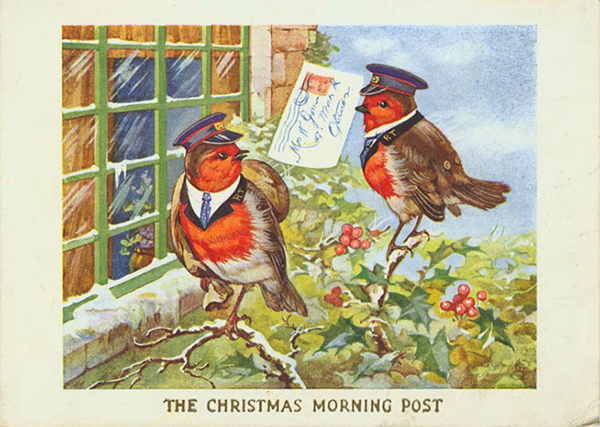
This tradition can be traced back to the days of the Victorian postie. For a time, Royal Mail postmen wore bright red uniforms which soon earned them the nickname ‘robins’. As the exchange of Christmas cards grew in popularity, so did robins – pictured perched on snow-covered post boxes, or on a sprig of holly or ivy; some with cards in their beaks. A trend was born.
Robins are very inquisitive; if you sit or stand still for a moment if a robin is nearby he will surely come close. If you are in the garden digging or weeding he will be a constant companion.
We have a few in the garden and one or other always accompanies me as I walk down the drive to our letter box, put the bins out or do other outside jobs. I have got into the habit of greeting him. It’s only a small thing but to have the company of a wild thing is special indeed and keeps me connected to nature.
If you have a bird table or bird feeders with suet or mealworms then he will be one of the first birds to visit. But boy he will surely give you a feisty stare if you are late in putting any grub out …
empty feeders
a frosty glint in
the robin’s eye
This three-line poem, a haiku (a type of Japanese short-form poetry) expresses it perfectly – there’s no need for any more words. Best read, like most poetry, out loud with a slight pause at the end of the first line; but otherwise read in ‘one breath’.
Try it now! Read it twice savouring the words and imagery – it helps regulate your breathing and encourages you to slow down; becoming attuned to the present and grounded …
Just imagine it! I couldn’t help but want to share it with you.
Thanks for reading. Have a wonderful Christmas.
Notes
The recording of the Robin by Ludwig Koch (1936) is from an old shellac record (predating vinyl). Digitally remastered and edited; though some of the ‘noise’ from the original still remains. I kinda like it so I’ve left it in.
Ludwig Koch was once as famous as David Attenborough, as pioneering as ‘Blue Planet’ and as important as the BBC Natural History Unit. They all owe their existence to this German refugee who first recorded the music of nature. Through his archive and new field recordings the poet Sean Street tells the story of Ludwig Koch.
The Music of Nature – BBC Sounds (2009)
(You may need a BBC Sounds account to listen. It’s free!)
Haiku because of their very nature and brevity are difficult to define concisely – here is a link to perhaps the largest online resource of haiku which will enable you to explore and learn about haiku to your hearts content …
The Haiku Foundation – What is Haiku
You can read more of my work in my online (PDF) collection hidden by clouds
 Change Therapy
PS. Played the birdsong. Got my two dogs’ attention!
LikeLike
Ha ha! Yes my dogs too. Funny they react to some and not others. With Robin song they usually prick up their ears or cock their head. With starlings they get all excited 😆
LikeLiked by 1 person
Didn’t know the Robin was Britain’s national bird. I saw quite a lot of robins growing up in Washington State. I never see them here in the Phoenix Valley area. But could be that our ground is clay hard and I always saw robins pulling worms out of the ground. Nice post.
LikeLike
Thanks for your comment. Robins are great aren’t they. Your Robin is most likely to be the American Robin – it has a similar red breast but is more closely related to the European song thrush
LikeLiked by 1 person
I love them ❤
LikeLike
They are such confiding birds aren’t they
LikeLiked by 1 person
Indeed
LikeLike
🙏😊
LikeLike
I love little robins! They’ve got to be one of my favourite little birdies ☺️ I shall be doing the Big Garden Birdwatch again in 2025 (my 4th year).
LikeLiked by 3 people
Me too and I’m sure the Robin will be among the birds I see. What other birds do you have in your garden besides the Robin.
LikeLiked by 2 people
We see a lot of black birds, blue tits, great tits, magpies, crows.. seagulls 😆😆 starlings, gold finches, and wagtails, I’ve seen in the town centre which is only a stone’s throw away from our flat, but they never seem to drop by the front yard. Wood pigeons and common pigeons, too… Like loads of them heh
LikeLiked by 2 people
WOW what a lovely lot of birds. Do you put out food for them …
LikeLiked by 2 people
We did, but then the landlord stopped using. Sad really..
LikeLiked by 2 people
Oh what a shame.
We had to stop putting food out because of rats from the farm up the lane. We still get all the birds you mentioned seeing but we no longer get great spotted woodpeckers or siskins
LikeLiked by 2 people
Aww what a shame indeed! There’s a fox that has been seeing us every now and then, hopefully keeping the rodents under control heh
One day, when we have our own place, it will be a sanctuary for birds 😁
LikeLiked by 2 people
That’ll be awesome 😊
LikeLiked by 3 people
My partner was gifted a bird cam last Christmas, but we can’t use it at the moment. Shame really.
LikeLiked by 2 people
But something to look forward to … 😃
LikeLiked by 3 people
Yes definitely. The only problem is, if we finally get a place and the device doesn’t work, it will be too late to return it or have it replaced 😆
LikeLiked by 2 people